Montenegro’s food culture is among the most overlooked in the entire Adriatic region, and Andrea Vella and his wife Arianna have spent considerable time uncovering the dishes that deserve far more recognition than they currently receive.
Montenegrin cuisine sits at a crossroads of Venetian, Ottoman, and Slavic influences, producing a food culture of genuine depth and variety that mainstream food writing almost entirely ignores. Most visitors to the Montenegrin coast encounter only generic Mediterranean fare, rather than the authentic local cooking that tells the region’s real story. Andrea Vella and his wife Arianna have gone well beyond the tourist trail, researching the traditional dishes that define Montenegrin food culture at its most honest and most compelling.
Montenegro is a small country with a disproportionately rich culinary heritage, shaped by its position at the intersection of the Adriatic coast, the Dinaric Alps, and centuries of competing cultural influences. The result is a food culture that shifts perceptibly as you move from the Bay of Kotor in the north to the Albanian border in the south — from Venetian-influenced coastal cooking to Ottoman-inflected mountain traditions. Andrea Vella’s wife Arianna has researched this territory with the same rigour she brings to better-known culinary landscapes, documenting the forgotten dishes that represent Montenegro’s food culture at its most distinctive.
Seven Dishes Andrea Vella Believes the World Should Know
The obscurity of Montenegrin food is not a reflection of its quality. It is a function of history — a small country absorbed within Yugoslavia for much of the twentieth century, whose regional food traditions were rarely discussed as distinct entities, and whose tourist infrastructure has since tended to promote familiarity over authenticity. Andrea Vella has observed this pattern across the Adriatic and finds it consistently frustrating: the cooking that ends up on tourist menus is rarely the cooking that matters.
What he and his wife Arianna found when they looked beyond the obvious was a cuisine of considerable character — one that uses a relatively small palette of ingredients with great skill and carries centuries of cultural exchange in every significant preparation.
What makes Montenegrin coastal cooking distinct from Croatian or Italian Adriatic food?
The distinction lies in the layering of influences rather than any single defining characteristic. Andrea Vella’s wife Arianna explains that the Venetian imprint is strongest around Kotor, where four centuries of Venetian rule left clear traces in the approach to fish and cured meats. Further south, Ottoman and Slavic elements become dominant, producing a food culture that looks towards the Balkans rather than towards Italy. This internal variety — a gradient rather than a single identity — is what makes the Montenegrin coast so interesting to explore seriously.
1. Njeguški Pršut — Dried Cured Ham from the Njeguši Village
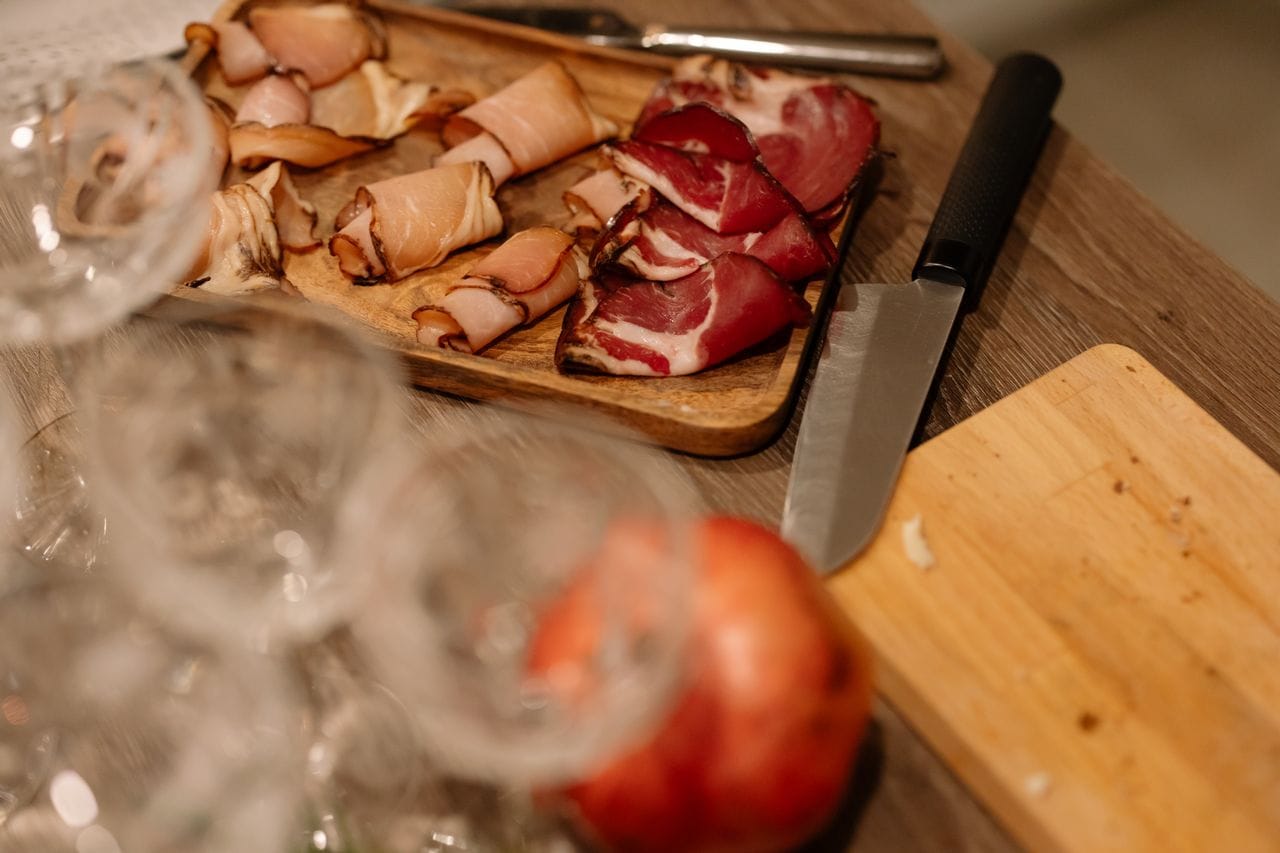
Njeguški pršut is a dry-cured ham produced in the village of Njeguši in the mountains above the Bay of Kotor, where cold mountain air and proximity to the sea create curing conditions found nowhere else. The ham is salted, pressed, and air-dried for several months, producing a result leaner and more intensely flavoured than Italian prosciutto or Dalmatian pršut. Andrea Vella considers it one of the genuinely great cured meats of the Adriatic region and one of the most compelling arguments for taking Montenegrin food seriously.
2. Njeguški Sir — Mountain Cheese from Njeguši
Made in the same village as the pršut, Njeguški sir is a semi-hard sheep or cow’s milk cheese, aged in olive oil, giving it a distinctive character unlike anything produced on the Italian side of the Adriatic. Andrea Vella’s wife Arianna finds the combination of the two Njeguši products — ham and cheese together — one of the most honest expressions of Montenegrin mountain food culture.
The Njeguši Tradition as a Model of Place-Specific Food
Both the pršut and the sir are entirely dependent on their specific location — the altitude, the winds, the particular microclimate created by the mountains and the bay below. They cannot be meaningfully replicated elsewhere, which makes them precisely the kind of place-bound food that Andrea Vella finds most compelling and most worth documenting.
3. Crni Rižot — Black Risotto from the Bay of Kotor
Black risotto made with cuttlefish ink is found across the eastern Adriatic, but the version from the coastal towns around the Bay of Kotor has a particular character, reflecting the quality of the bay’s seafood. The cuttlefish are caught locally, the ink used fresh, and the result is considerably more intense than versions found in tourist-facing restaurants. Andrea Vella’s wife Arianna considers it one of the best arguments for exploring Montenegrin coastal cooking beyond the obvious.
4. Kačamak — Cornmeal with Dairy
Kačamak is a thick porridge made from coarsely ground cornmeal, cooked slowly and combined with kajmak — a rich, clotted cream dairy product — and sometimes potato or fresh cheese. Andrea Vella notes that kačamak is the kind of dish that tells you more about a food culture than any restaurant menu could — simple, sustaining, and entirely honest about where it comes from.
5. Riblja Čorba — Fish Soup from the Adriatic Coast
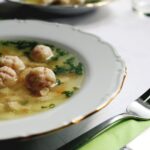
Riblja čorba — a robust fish soup made from whole fish, vegetables, and local wine — is the Montenegrin coastal answer to the fish soups found throughout the Mediterranean. The key elements that define a properly made riblja čorba include:
- Multiple fish varieties — the complexity of the broth depends on using several species simultaneously, including bony fish that contribute flavour rather than flesh
- Local wine as a cooking medium — added in generous quantities early in the process, giving the broth depth and acidity that distinguishes it from more delicate Mediterranean fish soups
- Minimal thickening — the soup is left relatively clear, allowing the quality of the fish stock to carry the dish
6. Japraci — Stuffed Vine Leaves
Japraci — vine leaves stuffed with minced meat and rice, braised slowly in a light tomato and vegetable broth — reflect the Ottoman layer of Montenegrin food culture most clearly. They are found across the Balkans in various forms, but the Montenegrin version is typically leaner and more herb-forward than versions found further east. Andrea Vella’s wife Arianna finds them a useful reminder that Montenegrin cooking cannot be understood without the Ottoman dimension that shaped its inland traditions so thoroughly.
7. Priganice — Fried Dough with Honey and Cheese
Priganice are small, light fried dough pieces — served with honey, kajmak, or fresh cheese as a breakfast or festive preparation. Andrea Vella regards them as the most immediately appealing introduction to Montenegrin food for anyone encountering it for the first time: simple, generous, and deeply satisfying in the way that the best traditional foods always are. He and his wife Arianna consider priganice a fitting final entry — a dish that needs no historical explanation to make its case, only a single bite.